

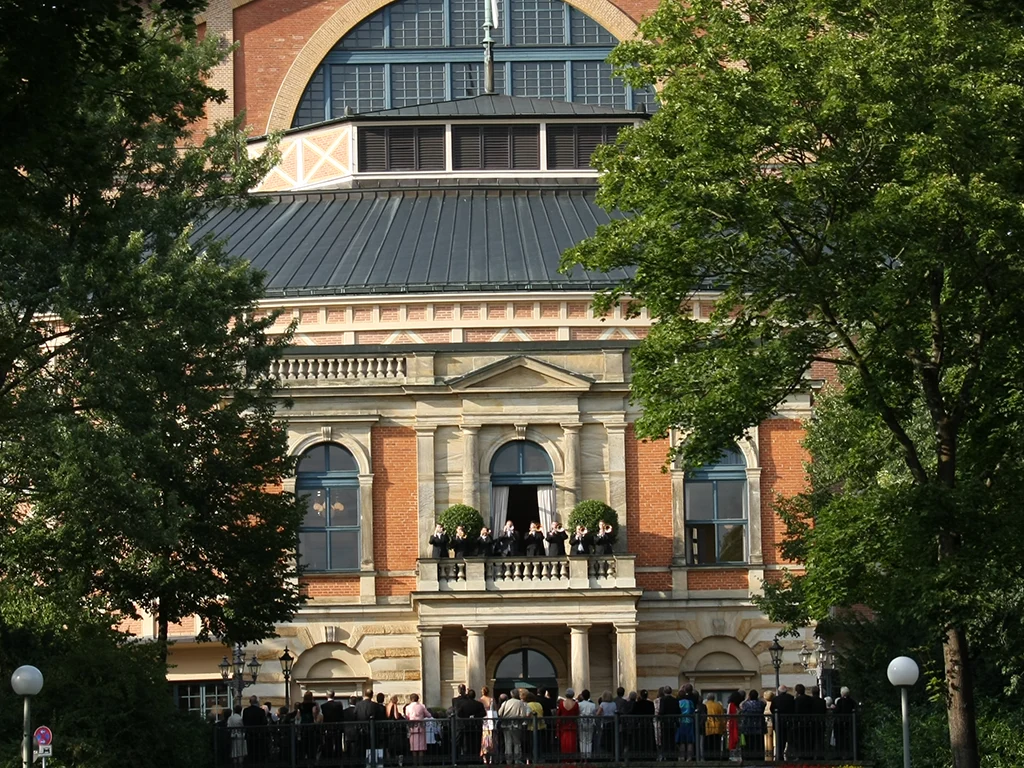
Especially in the year of its 150th anniversary, the Bayreuth Festival is deeply aware of its historical responsibility – both with regard to Richard Wagner’s antisemitic views and to the later close entanglement of the Festival and members of the Wagner family with National Socialism and its representatives.
Following the opening of the Festival with the anniversary ceremony on 25 July, we would therefore like to commemorate, on the following morning, 26 July 2026 at 10:30 a.m. in the Festspielhaus, those Jewish artists whose work on the Green Hill was brought to an end through antisemitism, persecution, and murder.
We feel privileged that Prof. Dr. jur. Dr. phil. Michel Friedman, despite the events of recent weeks which have significantly affected the public perception of our initiative, has once again agreed to deliver the commemorative address. In his speech, entitled “On Bayreuth, on Germany. An Attempt at a Social Analysis”, he will place Bayreuth’s historical responsibility within the broader context of German history and the present day.
The event will be accompanied musically by chamber music works by Gustav Mahler and Pavel Haas, as well as Richard Wagner’s Siegfried Idyll, conducted by Semyon Bychkov.
Admission is free (with tickets required). The donation proceeds, amounting to EUR 15,860.00, will benefit young Israeli musicians through the Keshet Eilon Music Center.
“It was particularly important to me that this event could take place as planned. Confronting the darker aspects of the history of the Bayreuth Festival is of central importance to me as Festival Director. I am therefore delighted to be able to welcome Michel Friedman to the Festspielhaus,” says Katharina Wagner.
“Katharina Wagner and I are approaching one another because our shared goal is to ensure that, on this symbolic and significant anniversary, there can be a demonstrative and constructive discussion of Richard Wagner’s antisemitism and the entanglements with Adolf Hitler that continued well into the 20th century. I was particularly impressed that Katharina Wagner has chosen to dedicate the proceeds of this event to young Israeli musicians. This sends an important political signal against antisemitism directed at Israel and against the authoritarian boycott of Israeli artists,” says Friedman in response.
The commemorative event “Verstummte Stimmen” (“Silenced Voices”) is being held in cooperation with the exhibition project of the same name, “Verstummte Stimmen”, which documents the expulsion of Jewish artists from German stages.